
American Red Cross
juli 1943
 For their Clubmobiles The American Red Cross wanted to recruit skilled and attractive
‘all-American girls’ between 25 and 35 years with work experience and in good health. Dorothy Jane and her sister Grace volunteered midway through the war as volunteers.
For their Clubmobiles The American Red Cross wanted to recruit skilled and attractive
‘all-American girls’ between 25 and 35 years with work experience and in good health. Dorothy Jane and her sister Grace volunteered midway through the war as volunteers.
Read the story: overview >
Departure for Europe
September 1943
 Dorothy and her sister Grace followed a short training at the ARC. Then - in September 1943 - they left for Britain. They were assigned to Group F van de Clubmobiles. Their Clubmobile was named 'Atlanta’.
Read the story: resources >
Landing on Utah Beach
July 16, 1944
 Dorothy Jane Burdge lands along with the other 'girls' of the American Red Cross Clubmobiles, Group F, on Utah Beach, 40 days after D-Day.From here her Clubmobile folllowed the VIII Corps.
See Dorothy's Combat route (1) >
Escaped from Bastogne
December 16, 1944, Bastogne
 On december 16 F-Group was attacked by surprise during the Battle of the Bulge (German 'Ardennenoffensief' and four Clubmobiles just managed to escape before Bastogne was surrounded.The return trip takes them through the now well-known places in this offensive: St. Vith and Vielsalm.
See Dorothy's Combat route (2) >
Germany,
Siegfriedlinie, March 15, 1945
 On March 15, 1945, the F-Group of the Red Cross Clubmobiles passed the German Siegfriedlinie and 10 days later they crossed the Moselle, and then crossed the Rhine at Koblenz. The march progressed rapidly.
See Dorothy's Combat route (3) >
The accident
Altenburg, May 1, 1945
 During a rest period 1st Lieutenant Lee A. Branch makes 'round trips' with a captured Arado 96 plane. The Clubmobile girls are invited for a ride. Grace made the first flight, followed by Dorothy. And that went fatally wrong ...
See Dorothy's Combat route (4) >
Buried in Margraten
June 19, 1945
 On May 4, 1945 Dorothy Jane was buried in Eisenach, Germany. A month later, she was transferred to the American cemetery in Margraten.
See Dorothy's Combat route (5) >
July 1943 (?)
Registration ARC
September 1943
to the UK
July 16, 1944
Landing on Utah Beach
March 15, 1945
Siegfriedlinie
May 1, 1945
Died on pleasure flight
June 19, 1945
Buried in Margraten, Block RR, Row 12 Grave 290
February 18, 1943
Air Evac. Nurse diploma
Jan. 15, 1944
Married
July 26, 1943
Body washed up
March - Augus 1943
Panama
June 1944
To Europa
November 23, 1943
Departure for Europa
January 20, 1944
Arriving in England
June 1944
Landing Omaha Beach
US enters the war
December 11, 1941
Nazi Germany declares war on the US
Turnaround WWII
Februari 2, 1943
Battle of Stalingrad: Red Army defeats Germans
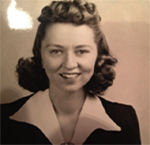
Dorothy Jane Burdge
An American Red Cross 'girl'
| Born: | August 14, 1915 |
| Location: | Marion County, Ohio |
| Family: |
|
| Education & profession: | Teacher |
| Military career: |
|
| Burial History: |
|
When we think about the American cemetery of Margraten, we usually associate it with the fallen soldiers who lie there. Male soldiers. To many people's surprise, there are also some women buried in Margraten, one of whom was not even employed by the military: American Red Cross 'girl' Dorothy Jane Burdge.
Growing up in the United States
Dorothy Jane Burdge was born on August 14, 1915 in Marion, Marion County, Ohio. When World War II broke out she was 24 years old. At that time she lived in Canton, Stark County, Ohio, and she had trained as a teacher.
Dorothy's parents were Burdge Leroy (1879-1769) &
Lilian A. Boescein (1884-1946). Dorothy had two sisters:
Edna Lilian (1912-2005) and Grace (1917-1999).
After the outbreak of the war Dorothy Jane and her sister Grace decide to register as volunteers with the American Red Cross.
The Red Cross
The Red Cross was founded in 1863 by the Swiss banker Henry Dunant (1828-1910). In 1859 he had happened to go to the battlefield a day after the Battle of Solferino (Italy) where the Franco-Sardinian alliance under Emperor Napeleon III had fought against the Austrian Army under Emperor Franz Josef I.
Dunant was appalled by what he found: on the battlefield 40,000 soldiers were lying wounded and dying, while no one took care of them. He immediately called on the people from the area, in particular the women, to help the soldiers. After returning home, he decided to write a book about his experiences. In that book, he also suggested the establishment of a neutral organization that would take care of the wounded during a war. Thus he laid the foundations for the Red Cross, which was founded in 1863 by Dunant and others. The purpose of the Red Cross has since expanded from assistance to wounded soldiers on the battlefield, to care for the wounded, sick and shipwrecked, of the armed forces at sea, war prisoners, refugees and civilians. Always in situations of war.
The Red Cross Clubmobiles
In World War II asked the American
American Red
Cross (ARC) – to contribute to recreational services for military personnel in various war zones. The ARC responded to this request and began setting up service clubs in London and other locations where military personnel were stationed. At the air bases, aero clubs were founded.
In order to reach soldiers on exercise outside the base, at airports and working elsewhere, the prominent New York banker Harvey D. Gibson, the Red Cross commissioner in Britain, came up with the concept of Clubmobiles: a service club on wheels. Clubmobiles were equipped with kitchens which had primus stoves to heat water for coffee, which could be stored in a 50-cup urn. There was also a donut machine.
Next to the kitchen there was an counter with a hatch from which the coffee and donuts were served. At the back of the bus was a 'lounge' with built-in couches on either side, which could easily be converted into a bed if needed. There was a Victrola record player with speakers, a large selection of up-to-date 75-rpm records and paperbacks.
(Note: In the Netherlands we could compare a Clubmobile to the 'Kadi' Canteen Service except that the coffee, donuts, cigarettes and chewing gum were free for the American soldiers.)
The Clubmobile were converted AEC buses from the
London transport company Green Line. These buses
were available because during the war the London Green
Line service had been suspended.
A total of 94 buses were purchased, of which 55 were converted into Clubmobiles.
The American Red Cross Clubmobiles began their work in Britain in the autumn of 1942, and eventually there were nearly thirty operating bases. Each bus was driven by a British driver, and three American Red Cross volunteers were assigned to each Clubmobile. From their bases the Clubmobiles would drive to the US military installations in the area. Fresh ingredients were brought and coffee and donuts made. The Clubmobiles drove to locations where soldiers were on exercise outside the barracks and established themselves in the vicinity of the airfield.
The arrival of a Clubmobile was announced by music blaring from speakers on board.
Red Cross ‘girls’
During the war Dorothy Jane and her sister Grace enlisted as volunteers. They both came through the selection process and followed a short training, You did not automatically become a volunteer for the American Red Cross Clubmobiles. The selection was strict. Candidates must have at least completed advanced training, have work experience and be between 25 and 35 years old. They also had to have good physical and mental health. Moreover, they had to look attractive.
Sending real all-American girls
was a deliberate choice by the American Red Cross. The morale
of US troops overseas was important. But the
girls were not supposed to encourage any advances. Jokes and the jitterbug were allowed, but nothing more!
The American Red Cross chose not to give any military ranks and deliberately called their female workers ‘girls’. To emphasize the non-military status, the uniform was a thin, gray dress with white shoes. The uniform was poorly suited to the working conditions and to the cold British climate. The dress was then quickly replaced by woollen RAF blue combat fatigues (battle dresses) and sturdy army boots.
Dorothy Jane en Grace left in September 1943 for Britian, along with a group of other volunteers. Here they were assigned to the Clubmobiles. They received training in London.
An article in The Milwaukee Journal on September 21, 1943:
In the basement of one of London's ancestral homes, in the heart of Mayfair, a donut school has been set up. Here pretty girls, newly arrived from the States, learn how to turn out donuts for the troops at the rate of 840 an hour. They wear white overalls and are easily the loveliest people that the Army has ever sent to England. There are nearly 500 American girls in the country working for the ARC. They are helped by more than 6,000 British volunteers. No task is too great or small for these girls to tackle. Some teach American troops London ballroom dancing and other hold daily classes in shorthand for US sailors.
There are no beauty bans in this service, and all the girls look glamorous
with their silk stockings, varnished nails and elegant footwear. The
British ATS, WAAFS and WRENS, look drab in comparison […] American
girls with their alluring accents, trim well cut uniforms, lovable natures and untiring zest for work and play have caused the English 'Tommy' a terrific heart throb.
Mee met de invasie
It became clear that an invasion from the American army on the European continent was imminent, so it was decided to convert a 2.5-ton GMC truck to Clubmobile. The converted Greenline buses were unsuitable for the conditions that one might encounter on the mainland.
The new Clubmobiles were equipped with a kitchen, which included coffee urns and a donut machine. Nearly 100 were produced. This time, no British driver went with it: the Red Cross girls who had worked on the larger Clubmobiles in Britain taught themsleves to drive and maintain the trucks. The Clubmobiles traveled along the line of an army corps and handed out coffee, donuts, cigarettes and chewing gum to soldiers returning from the front ...
In total 10 Clubmobile Groups were formed, each given a specific letter of the alphabet. They were added to the various army corps. A Clubmobile Group consisted of 32 girls, 8 Clubmobiles, a Cinemobile (mobile cinema), 3 supply trucks, two British Hillman-pick-up trucks (for quicker transport when the bus was not required and for convenience) and a jeep for the team leader.
The first Clubmobiles (Group ‘A’) made
over amonth after D-Day (link to the lemma ‘D-Day) the crossing
to Utah Beach. The Clubmobile Groups from then on followed
the advance, a journey that would take them from France to Luxembourg, Belgium, Netherlands and at the end of the war, even all the way to Germany.
The rise of F-Group through France, Belgium and Germany
When it became clear that an invasion of the American army on the European continent was imminent, it was decided to convert a 2.5-ton GMC truck to Clubmobile. The converted Greenline buses were unsuitable for the conditions that one might encounter on the mainland.
After spending some time in Brittany Group F followed the advance to Paris, and they found a new base at Bastogne in October 1944 and could supply the nearby troops with coffee, donuts, cigarettes and chewing gum. On December 16, 1944 theF-Group was surprised by the Germans who made a surprise attack in the Ardennes, and four Clubmobiles just managed to escape from Bastogne. The retreat led the group through the now well-known locations in this offensive: St. Vith and Vielsalm. After the failure of the German offensive the march to Germany was resumed.
On March 15, 1945 F-Group passed the German Siegfried Line, and 10 days later they crossed the Moselle River, and then crossed the Rhine at Koblenz. The march progressed quickly and after passing through Idstein, Eisenach, Ohrdruf and Bad Berka in Thuringen, the VIII Corps and the 6th Armored Division (to which the F-Group was added) reached the Czech border. It would not be long before the Americans would meet the Russians advancing from the east.
End of April 1945, the front stabilized and F-Group stopped
near Altenburg, southeast of Leipzig. From
there, moving canteen services came to serve the forces
of the 6th Armored Division.
Dorothy’s death
East of Altenburg was the German training airfield Fliegerhorst Leinawald. From 1943 the Blindfliegschule (blind flying school) 10 was stationed here, later renamed Jagdgeschwader (JG) 110. Here, German pilots learnt using only their instruments to 'fly blind'. After the German army had withdrawn from the airport, several training aircraft of the type Arado 96 were left behind.
During the war it was not uncommon for the Allied air forces to use captured aircraft. Often the US Army Air Force fighter squadrons were using these aircraft for reconnaissance and liaison flights. At the airport Leinawald, US troops used an Arado 96 and painted on American symbols, to prevent these planes being shot down by friendly fire.
On Tuesday, May 1st, 1945 the Clubmobile "Atlanta" in the F-Group, together with Dorothy Jane and Grace, was working at the airport Leunawald. That day 1st Lt. Lee A. Branch took several people on a round trip on the Arado 96 to let them enjoy the scenery below.
1st Lt. Lee A. Branch was an experienced fighter pilot in the
404 Fighter Group. In the 507 Fighter Squadron, he was one of the
most experienced pilots, decorated with the Distinguished Flying
Cross (DFC) and the Air Medal with 12 Oak Leaf Clusters (for every 10 missions flown got a pilot 1 OLC).
1st Lt. Branch was from the 404 Fighter Group commissioned by the headquarters ofIX Tactical Air Command and temporarily added to the headquarters of VIII Corps. Proper liaison officers - experienced fighter pilots - formed a link between ground troops who wanted to request air support from the air when the pilots had to carry out ground attacks. The use of such Air Liaison Officers of Forward Air Controllers reduced the risk that troops would be hit by the shelling or bombings by German troops.
After Branch had made several trips, the American Red Cross girls were invited for a tour in the two-seater aircraft. Grace made the first flight, followed by Dorothy. And that was wrong, fatal ...
In his attempt to fly under a high voltage cable and as he took off, a wing tip caught a tree and the plane crashed 200 meters east of the village of Munsa. The crash was witnessed by Corporal Frank B. Cesario and soldier Ruben Corrall A-Peloton, 86 Cavalry Reconnaissance Squadron of the 6th Armored Division. They immediately rushed to the scene of the accident and pulled lieutenant Branch out of the aircraft. Not knowing that there was a passenger in the now burning aircraft, they investigated no further.
Only after the fire was extinguished they find the body of the
passenger - Dorothy Jane -. Both bodies were immediately
taken to the 618 Clearing Hospital, stationed at the airport.
Flight Surgeon Earl W. Douglas examined the remains, and concluded the following cause of death, ‘frontal fracture of the skull’. Lee A. Branch and Dorothy Jane Burdge both very likely died instantaneously.
Gretchen Schuyler, team leader of Club Mobile Group F wrote - in addition to the above facts - in a report to their superiors:
"Jane's dog tags were handed over to the Graves Registration Service of the 6th Armored Division. Her funeral will be held at the American cemetery in Eisenach, Germany. Grace Burdge has Jane's personal belongings. It is with great sadness that I report this. Jane was one of the best overseas American Red Cross girls. She was well-liked by all who had the good fortune to know her. Her qualities made her a fine ARC Clubmobile employee - carefree and enthusiastic - this endeared her to her many friends. Unfortunately, these qualities also caused her premature death".
Dorothy Jane Burdge was on May 4, 1945 -. 3 days after the accident - buried in the (temporary) American cemetery in Eisenach, Germany. On 19 June 1945 she was reburied at the American cemetery in Margraten, Block RR, Row 12, Grave 290. After the reorganization of the cemetery she found her final resting place in Block B, Row 7, Grave 4.
1st Lt. Lee A. Branch found his final resting place in the United States.
Fields of Honor Database
Downloads
- Passport Dorothy Jane Burdge
-
Thesis on ARC 'girls'
"'Girls' in Name Only: A Study of American Red Cross volunteers of the Frontlines of WWII" by Julia A. Ramsey.
Literatuur
- Slinging Doughnuts for the Boys: An American Woman in World War II (Indiana University Press, 2007).
Images


Video's
Weblinks
-
Eyewitness Report from ARC 'girl' Jill Pitts Knappenberger
"Red Cross Clubmobile at Your Service" by Jill Pitts Knappenberger (Clubmobile 'Cheyenne F-Group') -
Verhaal over ARC 'girl' Elizabeth Richardson
"Wearing Lipstick to War. An American Woman in World War II England and France" by James H. Madison -
Een korte geschiedenis van
de Clubmobiles
"A Brief History of Red Cross Clubmobiles in WWII" by Elma Ernst Fay (U.S Red Cross rtd) - Verhaal over Women In Wartime - ARC Clubmobile