
In service
October 5, 1942, Camp Bragg
 George Brouillette enlisted in the US Army on October 5, 1942, a few days after his 21st birthday. He received his basic training at Camp Bragg where he was trained as an infantryman.
Read the story: military file >
In Panama
March - August 1943
 George's first training period probably lasted about four months, until February 1943. Then he was sent to Panama for six months, to assist in the security of the Panama Canal. Here he remained until August 1943.
Read the story: military file >
In Europa
June 1944
June '44 George made the crossing to Europe. On his arrival in September he was placed with G Company, 2nd battallion 117 Infantry Regiment, 30 Infantry Division. After heavy losses the unit required reinforcements.
Read the story: Resources >
Liberation South Limburg
Maastricht, 13 sept. 1944
 1944 George June '44 made the crossing to Europe. On his arrival in September he was placed with G Company, 2nd Battalion, 117 Infantry Regiment, 30 Infantry Division. After heavy losses the unit required reinforcements.
Read the story: Combat route (1) >
Rest center Rolduc
2-5 nov. ‘44 Kerkrade
 On November 2, 1944 the positions of George's battalion were taken over by Infantry regiment 406, 106 Infantry Division. George and his comrades could rest in Rest Camps near Heerlen and Kerkrade.
Read the story: Combat route (2) >
Killed
Mariadorf, 1944 Nov. 16
 On 16 Nov 1944. George's unit launched an attack on Mariadorf and found themselves in an area filled with anti-personnel mines. On that day many solders were killed or injured by mines. George stepped on a mine and was seriously injured. He died a day later.
Read the story: Combat route (3) >
July 1943 (?)
Registration ARC
September 1943
to the UK
July 16, 1944
Landing on Utah Beach
March 15, 1945
Siegfriedlinie
May 1, 1945
Died on pleasure flight
June 19, 1945
Buried in Margraten, Block RR, Row 12 Grave 290
February 18, 1943
Air Evac. Nurse diploma
Jan. 15, 1944
Married
July 26, 1943
Body washed up
March - Augus 1943
Panama
June 1944
To Europa
November 23, 1943
Departure for Europa
January 20, 1944
Arriving in England
June 1944
Landing Omaha Beach
US enters the war
December 11, 1941
Nazi Germany declares war on the US
Turnaround WWII
Februari 2, 1943
Battle of Stalingrad: Red Army defeats Germans

George Brouillette
Liberator of South Limburg
| Born: | October 2, 1921 |
| Location: | Holyoke, Massachusetss |
| Family: |
|
| Education & profession: | After two yearsCollege George started working at D. Mackintosh & Sons, the dye works in the textile industry |
| Military career: |
|
| Burial History: |
|
George R. Brouillette
Infantryman in the "Old Hickory"
George R. Brouillette of Holyoke, Massachusetts, served as a soldier
in the liberators of South Limburg, the 30th "Old Hickory" Infantry Division.
Before the war he worked in the textile industry and during the war he was an infantryman. As a soldier in the "Old Hickory" division, he was part of the liberation of South Limburg in September 1944. Two months later he found himself with his comrades at the front just over the border in Germany. Stepping on an German anti-personnel mine was fatal and on November 17, 1944 he died of his injuries. George R. Brouillette was 23 years old.
'Adopted'
George R. Brouillette was born on October 2, 1921. His birth certificate shows that his mother was Marie Eugeunie Auglor Brouillette, she was called Oglore. The father's name is not mentioned. Oglore Brouillette was at that time only 18 years (born 30-11-1902).
As a single mother Oglore Brouilette was unable to care for her newborn son so he was then adopted by his grandmother: Marie Brouillette - Lavoine (21-10-1882 -).
From then on George was considered to be Marie's son. The name of his biological mother was kept from him and others around him. George never knew and he always thought that he was adopted. Oglore Brouillette died very young on October 17, 1942 of lung cancer and took her secret to her grave. George at that time had just joined the army and probably did not attend her funeral.
His half-brother and half-sister Rita Raymond were the children Oglore
had after her marriage to Sylvio Peloquin, after George's death
they found out that he was their half brother. Until then they had always
thought he was a cousin.
Why the family kept this secret for so long is not clear, but it was possibly because George was illegitimate.
Holyoke
George grew up in Holyoke with his grandmother Marie and her daughter (his aunt) Yvonne. Holyoke is located on the Connecticut River – in Massachusetts. The place was named after Elizur Holyoke, a settler who explored the area in the years around 1650. Holyoke was founded in 1745. From the middle of the 19th century, it became an industrial center, as can be seen on the town seal.
George lived with his grandmother and aunt in a neighborhood of Holyoke called The Flats, a working-class neighborhood where predominantly French-Canadian emigrants lived. (George's grandfather was a Canadian).
Although George and Raymond did not know they were half-brothers they used to play together. They did what all boys did: fishing, swimming and all kinds of sport. Both were highly skilled in baseball. According to Roland Pelissier, a childhood friend, George excelled in baseball and could well have reached the very top in that sport. An old photo from 1930 of Holyoke Yankee Baseball Team is George (erroneously named as Doug) among his teammates.
As a child he attended the Immaculate Conception, which was run by
nuns. In a school photo
uit 1937 van de from 1937 of group 8 (8th grade)
George is standing among
his classmates.
After his school years he attended two years of College, after which he went to work at D. Mackintosh & Sons. He probably worked in the mill which powered the machines. The textile industry was very important in Holyoke and other cities in Massachusetts.
George continued to work at D. Mackintosh & Sons until he was called to serve in the army.
The infantry
George Brouillette enlisted in the infantry on October 5, 1942, a few days after his 21st birthday. He received his basic training atCamp Bragg in North Carolina, where he was trained as an infantryman.
The infantry is traditionally the part of the army that foughton foot; unlike the cavalry which wason horseback. Until the First World War soldiers on horseback played a vital role, but after the Second World War this changed completely. The army was now a motorized army.
The infantry combat training was tough and only the fittest men were assigned to the infantry. During the combat training the focus was on rifle shooting, throwing grenades, digging foxholes, hand-to-hand combat, and so on.
George's first training period probably lasted about four months,
until February 1943. Then George was sent to Panama for six
months to help secure the Panama Canal. Here he
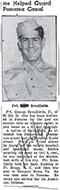
remained until August 1943. During a short leave of 21 days in June 1943 there was an article written about him that appeared in the local paper. In the photograph he is smiling broadly.
Letters
After Panama he was stationed at Camp Roberts in California. Here he received further training. From this period there is a letter that gives us a glimpse into George's life. On December 22, 1943, he writes from Camp Carson in Colorado the following letter to his half-brother Raymond:
Hi Raymond, I’m dropping a few lines to let you know that I’m feeling fine and I hope you are too and the rest of the family. I went out on a night patrol and stayed out all night, it’s sure cold at night over here. I slept in a sleeping bag, it’s about 6 feet long. I was pretty warm even though it was pretty cold. Next morning when we got up the sleeping bag was covered with frost.
Remember the first night I went up with you to Estelle Provost to see her, well she’s my girl. She told me that she sees you everyday when she goes to work but you don’t see her.
How’s everything over there? Anything change since I left? Today I’m going on guard duty. They sure gave us a lot of clothes and different other things. They gave us big boots, a new field jacket, a new mountain tent, a jungle parka, gloves and winter pants. But we’re just going to keep them for the winter time, after that we’ll turn them in. I am hoping I won’t gat K.P.* for Christmas. Well I think that’s all for now, till I hear from you soon.
Your cousin, George
PS: I made Private First Class. I was surprised when I saw my name on the
board.
* K. P. is short for "Kitchen police" or "Kitchen patrol". George hopes that he will not be on duty in the canteen during Christmas.
As can be seen from the letter, George is concerned by the things that occupied hundreds of thousands of American soldiers at that time: military exercises, the equipment (he may never have seen a sleeping bag before) , the home front, andlast but not least last but not least his girlfriend at home: Estelle Provost. Finally, he also let Raymond know that his rank was now Private First Class (aka Soldier first class).
Old Hickory
George Brouillette June 1944 makes the crossing to Europe. He was probably part of the reinforcements and was with G Company, 2nd Battalion, 117 Infantry Regiment, 30 Infantry Division. They had arrived in England on February 22 1944 and landed on Omaha Beach on June 11, 1944. George probably joined this division in September, after they had suffered heavy losses and needed reinforcements.
The name 30 Infantry Division The name 30 Infantry Division may not ring any bells with you at first, but that might change once you see the name Old Hickory. The Old Hickory was the division that liberated South Limburg in September 1944 and was under the command of Major General Leland Hobbs.
After the liberation of Paris in late August 1944, the division marched
to Belgium. On September 10th they crossed the Meuse at Vise and
Liege. In the following days they liberated South Limburg.
The 2nd Battalion of the 117th Regiment was ordered to turn from Eijsden, near the Belgain border, towards Maastricht. The G-company of the 2nd Battalion, in which George served, went through Gronsveld and towards Heer. Maastricht had been more or less deserted by the Germans and could therefore be freed almost without a fight. The western part of the city was liberated on September 13, as well as Margraten. The eastern part of Maastricht was liberated a day later.
It is probable that George Brouillette was present throughout. The irony is that George could not then have suspected that a few months later he would return to South Limburg to find his final resting place at the American Cemetery in Margraten.
After the liberation of South Limburg the "Old Hickory" division continued on to Aachen, which was taken on October 16. The next obstacle waiting for them was the last great German defense: the Siegfried Line.
"The infantry will kill you or make a man out of you"
A few days before the capture of Aachen George writes a letter (his last) to Raymond. The letter is dated October 10, 1944.
George writes that he is somewhere in Germany. Presumably
he and his comrades were at that time in Schaufenberg
part of the city Alsdorf, between the Dutch-German border
to the west and the Siegfried Line on the east side. At that time he was close to the front. George writes:
Hi Raymond,
I received your letter the other day. I was sure glad to hear from you. I’m feeling fine and hope you are too and the rest of your friends. So they got you in the infantry also. Yes, the infantry will kill you or make a man out of you. Yes Raymond, I miss you very much. But while I am in this fight I won’t be able to write to you very often. I’ll write when I have spare time. I hope you don’t see no action because it’s tough and I’m not kidding. I know you train for it. I am writing this letter somewhere in a house in Germany. Well, I guess that’s all for now till I hear from you soon.
Your cousin, George.”
It is clear that the cheerful tone of George's last letter here has completely disappeared. He even wrote the prophetic words: "The infantry will kill you or make you a man." He has also apparently seen so much of war that he hopes Raymond will never have to participate in combat operations. George signed the letter "Your cousin; George'. This shows again that George never knew Raymond Peloquin was actually his half-brother.
A short break
On November 2, 1944 George's battalion positions
were taken over by units of406 Infantry Regiment, 106 Infantry
Division. The men of 117 Infantry Regiment can just rest in Rest Camps near Heerlen and Kerkrade. It is known that the men from Old Hickory at that time were in Rolduc, where such a Rest center was situated.
In one surviving picture we see how soldiers
from the Old Hickory division in the Rest Center
Rolduc are treated by Clubmobile girls
to coffee and snacks. But the peace
was short-lived, and around
November 5 the unit returned
to the front line.

Victim of a mine
On November 16 - a cold and foggy day - George's unit carries out an attack on Mariadorf (just across the border from Eijgelshoven) in an area dotted with so-called Schützenmine. These anti-personnel mines, usually abbreviated to Schü-mine, were specifically targeted to soldiers on foot and could inflict terrible injuries.
The mine consisted of a simple wooden box with 200 grams of explosive (TNT) and a detonator. Because there are no metal parts in these mines, they could not be detected by mine detectors. By placing them in a bed of pebbles they were even more effective. Sometimes the mine was was filled with scrap metal which of course made them easier to detect.
The explosion of a Schü mine would result in injuries
above or below the knee in one leg.
Often, the other leg was so badly injured by the blast and flying stones,
that it had to be partially amputated.
As the front had been stalled for about a month it gave the Germans plenty of time to place mines. Any advance made in this area was therefore extremely dangerous for the infantry, as it turned out to be on that day. There were many casualties that day among the advancing infantry.
George stepped on a mine and was seriously injured. He was taken to a field hospital in Heerlen. Medical assistance was of no avail. The day after on November 17, 1944, George Brouillette died of his injuries, only 23 years old.
Despite the many victims George's unit was able to take Mariadorf. 104 German soldiers were taken prisoner.
Last belongings
After the death of a soldier, the US make a report called Individual Deceased Personnel File (usually abbreviated as IDPF). In it were, along with other personal information, the cause of death and the contact information of the family. The report also included a list of the personal belongings of the deceased.
George's personal belongings:
|
All his other possessions such as his clothes, weapons and other equipment, were the property of the Army. Anything that was in good condition was reused.
Awards
George Brouillette was buried at the American cemetery in Margaten. He has his final resting place in Block G, Row 9, Grave 15.
George Brouillette was decorated for his military deeds with several medals. During his active duty he was awarded the Bronze Star Medal, the Distinguished Service Cross, the Silver Star and the Combat Infantry man’s Badge.
Posthumous followed the Purple Heart, the World War II Victory Medal and theEuropean-African-Middle Eastern Theater Campaign Medal with 1 Bronze Service Star.
His grave was adopted some time ago by Harry Beckers former deputy mayor and councilor of the former municipality of Margraten.
Fields of Honor Database
Downloads
-Literature
-Videos
Images


Webinks
- “WWII casualty haunting story”, newspaper ‘The Republican’, 25-1-2009
- “Netherlands visit to grave of ‘our soldier’, PFC George Brouillette of Holyoke, deeply moving”.
- “PFC George R. Brouillette, search for ‘Nigger.’” Website Ben Savelkoul.
-
30 Infantry Division, ‘Old Hickory’:
http://en.wikipedia.org/wiki/30th_Infantry_Division_(United_States)
http://www.30thinfantry.org/history.shtml
http://www.oldhickory30th.com/
http://www.history.army.mil/documents/ETO-OB/30id-eto.htm
http://www.unithistories.com/units_index/default.asp?file=../units/30th%20Inf.Div.asp
http://oldhickoryfundmaastricht.nl